
Table of Contents
Introduction
Digital marketing is changing fast.
In 2026, businesses are not doing marketing manually like before. They are using AI tools to:
-
Create content
-
Run ads
-
Send emails
-
Improve SEO
-
Analyze data
-
Save time
Earlier, marketing required big teams and large budgets. Today, even small businesses can compete with big brands using AI tools.
In this guide, you will learn:
-
How to use AI for content marketing
-
How to use AI for ads
-
How to use AI for email marketing
-
How to use AI for SEO
-
Real examples
-
Productivity comparison tables
-
Step-by-step beginner guide
Let’s start.
Why AI Is Important in Digital Marketing (2026 Data)
In 2026:
-
78% of marketers use AI tools daily
-
64% of businesses say AI improved ROI
-
52% reduced marketing costs using automation
-
45% improved customer targeting
AI helps businesses achieve:
-
Faster work
-
Better targeting
-
More conversions
-
Lower marketing costs
AI is not replacing marketers.
It is helping them work smarter.
How to Use AI for Content Marketing
Content marketing includes:
-
Blog writing
-
Social media posts
-
Video scripts
-
Product descriptions
-
Website copy
AI helps generate:
-
Content ideas
-
Blog outlines
-
Social captions
-
Ad copy
-
Full draft articles
Popular AI Writing Tools
You can use:
-
ChatGPT
-
Jasper AI
-
Copy.ai
-
Writesonic
These tools help speed up content creation.
What AI Can Do for Content
AI can:
-
Generate blog outlines
-
Suggest SEO headlines
-
Write ad copy
-
Rewrite existing content
-
Translate content
-
Create content calendars
Example Workflow for Content Creation
Step 1: Ask AI for blog topic ideas
Step 2: Generate a detailed outline
Step 3: Create first draft
Step 4: Edit and adjust tone
Step 5: Optimize for SEO
AI gives speed.
Humans give creativity.
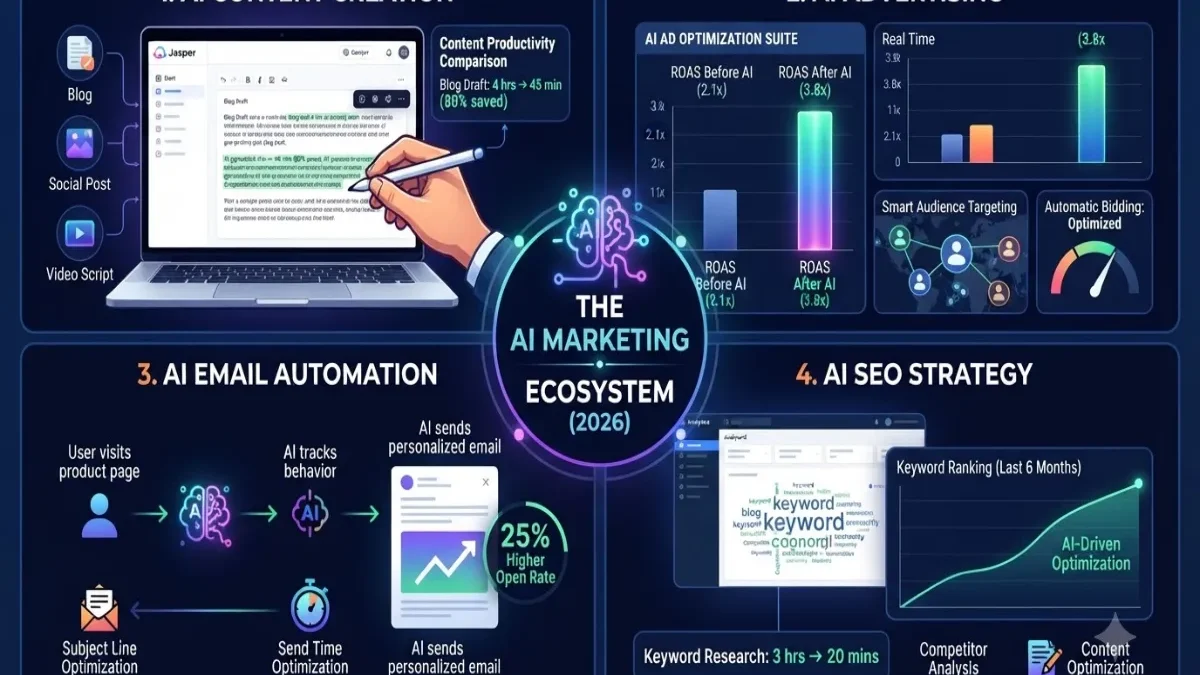
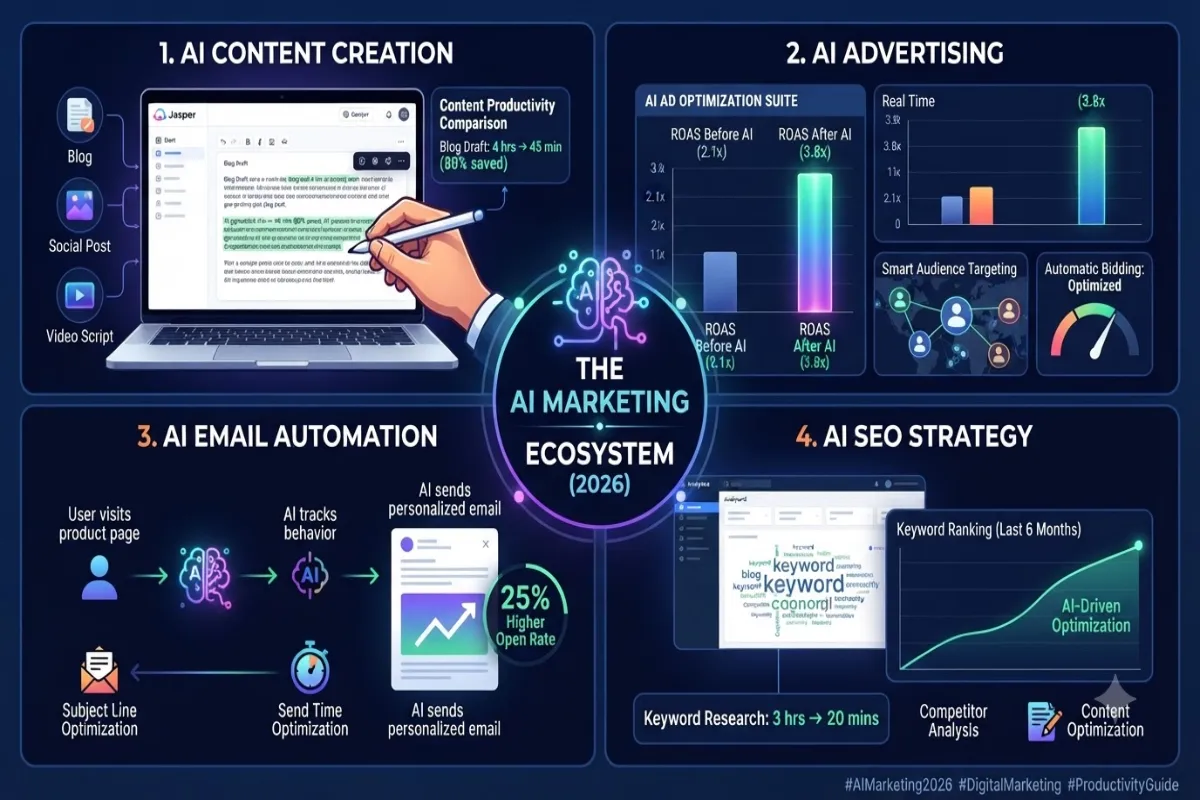
Content Productivity Comparison Table
| Task | Manual Time | With AI | Time Saved |
|---|---|---|---|
| Blog Draft | 4 hours | 45 minutes | 80% |
| Social Posts | 2 hours | 20 minutes | 83% |
| Email Copy | 1 hour | 10 minutes | 83% |
| Ad Headlines | 1.5 hours | 15 minutes | 83% |
AI does not replace humans.
It makes work faster and more efficient.
Add Image Here (After Content Table)
Image idea: Laptop showing AI writing tool generating content
Alt text: AI content writing tool in action
How to Use AI for Paid Ads (Google & Social Media)
AI plays a big role in digital advertising.
Platforms like:
-
Google Ads
-
Meta
-
TikTok
Already use advanced AI systems.
How AI Helps in Advertising
AI helps with:
-
Smart audience targeting
-
Automatic bidding
-
Budget optimization
-
Performance prediction
-
Ad copy suggestions
Real Example
Small eCommerce store:
Before AI:
-
ROAS = 2.1x
After AI targeting:
-
ROAS = 3.8x
-
Ad cost reduced by 27%
AI improves results while reducing waste.
AI Ad Optimization Table
| Feature | Without AI | With AI |
|---|---|---|
| Audience targeting | Manual | Smart AI targeting |
| Budget allocation | Fixed | Auto optimized |
| A/B testing | Slow | Automatic |
| CTR improvement | 2–3% | 4–6% |
Add Image Here (After Ads Section)
Image idea: Advertising analytics dashboard
Alt text: AI digital advertising dashboard 2026
How to Use AI for Email Marketing
Email marketing still delivers strong returns.
In 2026:
-
Average ROI is $36 for every $1 spent
AI improves:
-
Subject lines
-
Personalization
-
Send timing
-
Audience segmentation
-
Automation
Tools for AI Email Marketing
You can use:
-
Mailchimp
-
HubSpot
-
ActiveCampaign
Benefits of AI in Email Marketing
AI can deliver:
-
25% higher open rates
-
18% higher click rates
-
30% better personalization
-
40% time savingsAI Email Automation Example
-
User visits product page
-
AI tracks behavior
-
AI sends personalized email
-
AI sends follow-up reminder
-
AI stops campaign after purchaseThis improves conversions automatically.
How to Use AI for SEO in 2026
SEO has become smarter.
Search engines use AI to rank websites.
For example:
-
Google uses AI-based ranking systems.
AI SEO Tools
Popular tools include:
-
Surfer SEO
-
Semrush
-
Ahrefs
What AI Does in SEO
AI helps with:
-
Keyword research
-
Competitor analysis
-
Content optimization
-
Internal linking suggestions
-
Rank tracking
SEO Productivity Table
| Task | Manual | AI Assisted |
|---|---|---|
| Keyword research | 3 hours | 20 minutes |
| Content optimization | 2 hours | 30 minutes |
| Backlink analysis | 2 hours | 25 minutes |
AI reduces research time significantly.
Real Business Example 1
Local digital agency.
Before AI:
-
5 employees
-
20 clients
-
Slow reporting process
After using AI tools:
-
3 employees
-
35 clients
-
Automated reporting
-
40% higher profit
AI reduced workload and improved profit.
Real Business Example 2
Online clothing store.
Used AI for:
-
Product recommendations
-
Retargeting ads
-
Email automation
Results in 6 months:
-
32% increase in sales
-
24% lower ad spend
-
18% higher customer retention
Step-by-Step Beginner Setup Guide
Step 1: Choose one AI writing tool
Step 2: Use AI for content ideas
Step 3: Start email automation
Step 4: Enable AI ad targeting
Step 5: Use AI SEO tool
Step 6: Track ROI
Step 7: Optimize every month
Start small.
Scale gradually.
Industry Benchmark (2026)
| Channel | AI Adoption % | Average ROI Increase |
|---|---|---|
| Content | 72% | +38% |
| Paid Ads | 68% | +42% |
| 61% | +35% | |
| SEO | 55% | +31% |
AI marketing is no longer optional.
It is becoming standard practice.
Future of AI in Digital Marketing (2027–2030)
AI will improve:
-
Voice search marketing
-
AI-generated video ads
-
Predictive customer behavior
-
Real-time personalization
-
Virtual AI influencers
Marketing will become:
-
More automated
-
More data-driven
-
More personalized
Security and Privacy
When using AI tools:
-
Protect customer data
-
Use secure platforms
-
Follow GDPR and data rules
-
Avoid sharing sensitive information
-
Review AI output manually
AI should be used responsibly.
Pros and Cons of AI in Marketing
Pros
-
Saves time
-
Reduces costs
-
Improves targeting
-
Increases ROI
Cons
-
Requires monitoring
-
Learning curve for beginners
-
Risk of over-automation
Balance is important for long-term success.
Final Thoughts
AI is not just the future.
It is the present.
Businesses that use AI in 2026:
-
Grow faster
-
Spend less
-
Work smarter
If you run a blog, startup, or small business, now is the right time to adopt AI in digital marketing.
Start small.
Test tools.
Track results.
Improve monthly.