

Table of Contents
Introduction
Money is changing.
In the past people used coins and paper notes.
Today many people use phones and computers to pay.
This change is called digital currency.
Digital currency means money that exists in electronic form.
It is stored on computers, mobile apps, or digital wallets.
People can send digital money quickly through the internet.
There is no need to carry physical cash.
Many experts believe digital currency will become the main form of money in the future.
Some popular digital currencies include Bitcoin and Ethereum.
Governments are also creating their own digital money.
For example, India is testing the Digital Rupee under the Reserve Bank of India.
Digital currency is becoming more common every year.
What Is Digital Currency
Digital currency is money that exists only in electronic form.
It cannot be touched like coins or paper money.
Instead, it is stored digitally.
People can send it using:
- Mobile apps
- Online banking
- Cryptocurrency wallets
- Digital payment systems
Digital currency allows fast payments across the world.
Simple Definition
Digital currency is electronic money that people use for online payments and digital transactions.
Types of Digital Currency
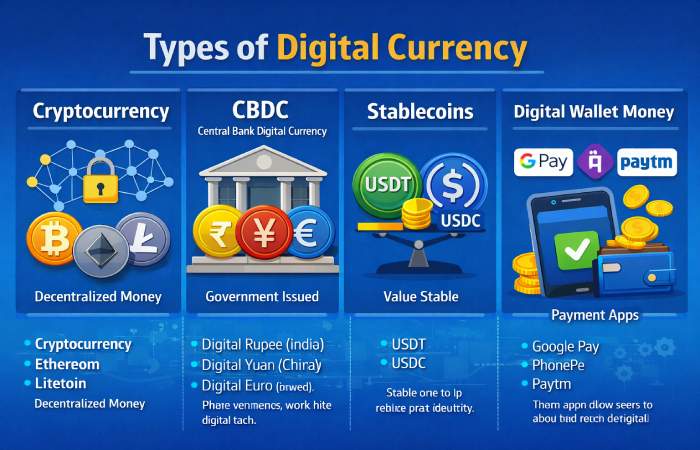
There are several types of digital currency.
Each type works in a slightly different way.
-
Cryptocurrency
Cryptocurrency is decentralized digital money.
It works using blockchain technology.
No government directly controls it.
Popular cryptocurrencies include:
- Bitcoin
- Ethereum
- Litecoin
Cryptocurrency is often used for investment and online payments.
-
Central Bank Digital Currency (CBDC)
CBDC is digital money issued by a government.
Central banks control this currency.
Examples include:
- Digital Rupee (India)
- Digital Yuan (China)
- Digital Euro (planned)
These currencies work like digital cash.
-
Stablecoins
Stablecoins are cryptocurrencies connected to stable assets like the US dollar.
Their value usually stays stable.
Examples include:
- USDT
- USDC
Stablecoins help reduce price volatility.
-
Digital Wallet Money
Some digital currencies exist inside payment apps.
Examples include:
- Google Pay
- PhonePe
- Paytm
These apps allow users to send and receive digital money instantly.
Digital Currency vs Physical Currency
This table shows the difference between digital money and traditional cash.
| Feature | Digital Currency | Physical Currency |
| Form | Electronic | Paper or coins |
| Speed | Instant transfer | Slow manual payment |
| Storage | Digital wallet | Wallet or bank |
| Security | Encrypted systems | Can be lost or stolen |
| Global use | Easy international use | Harder to send abroad |
Digital currency is faster and more convenient for modern payments.
How Digital Currency Works
Digital currency works using computer networks.
Transactions happen through secure systems.
Many cryptocurrencies use Blockchain.
Blockchain is a digital record of transactions.
Every transaction is stored permanently.
Simple Process
- User sends payment from digital wallet
- Network verifies transaction
- Transaction is recorded
- Receiver gets the money
This process usually takes only a few seconds or minutes.
Global Digital Currency Adoption
Digital currency adoption is growing quickly worldwide.
Many countries are researching or developing digital currencies.
Global Digital Currency Trends
| Trend | Growth |
| Countries researching CBDC | 130+ countries |
| Central banks exploring CBDC | 90% |
| Crypto users worldwide | 420+ million |
| Expected crypto users by 2030 | 1 billion+ |
Source: Bank for International Settlements CBDC surveys and global crypto adoption reports.
Digital Payments Growth in India

India is one of the fastest growing digital payment markets.
The government and fintech companies have helped increase digital transactions.
Digital Payment Growth Table
| Year | Digital Payment Growth |
| 2018 | 35% |
| 2020 | 55% |
| 2022 | 72% |
| 2024 | 89% |
| 2025 | 95% |
Global Digital Currency Trends
| Trend | Growth |
| Countries researching CBDC | 130+ |
| Central banks exploring CBDC | 90% |
| Crypto users worldwide | 420M+ |
According to the Bank for International Settlements CBDC survey, more than 90% of central banks are researching digital currency systems.
Source:
Advantages of Digital Currency
Digital currency provides many benefits.
Fast Transactions
Payments happen almost instantly.
Even international payments are faster.
Lower Costs
Digital payments reduce bank processing fees.
Some cryptocurrency transfers cost very little.
Global Accessibility
Anyone with internet access can use digital currency.
Transparency
Blockchain technology records all transactions.
This increases transparency and reduces fraud.
Financial Inclusion
Digital currency helps people without traditional bank accounts access financial services.
Disadvantages of Digital Currency
Digital currency also has some challenges.
Price Volatility
Cryptocurrency prices can change quickly.
For example, the value of Bitcoin can rise or fall dramatically.
Cybersecurity Risks
Hackers may try to steal digital assets.
Users must protect their wallets.
Regulation Issues
Different countries have different rules for digital currency.
Some governments support it while others restrict it.
Internet Dependency
Digital currency requires internet access.
Without internet, transactions may not work.
Future of Digital Currency
Experts believe digital currency will grow rapidly.
More governments are exploring digital money systems.
Blockchain technology is improving security and transparency.
Future Trends by 2030
| Trend | Expected Development |
| CBDC adoption | 80+ countries |
| Crypto users | 1 billion+ |
| Cashless payments | Major global growth |
| Blockchain banking | Mainstream technology |
Source: International Monetary Fund and fintech industry reports.
Conclusion
Digital currency is changing the way people use money.
It offers faster transactions, global accessibility, and improved financial technology.
Cryptocurrencies, stablecoins, and government digital currencies are all part of this transformation.
As technology continues to evolve, digital currency may become the main form of money worldwide.
Understanding digital currency today will help individuals and businesses prepare for the future of finance.