
Table of Contents
Introduction
In present-day India, mobile applications, internet banking, UPI transactions, and social media use have become commonplace. This might have made things convenient, but it has also introduced several cyber vulnerabilities. Spoofing is one such risk that you need to be aware of.
It is a technique adopted by hackers to pose as someone else. They do this to obtain your private information and even financial gains.
This paper will help you understand spoofing in an extremely simplified manner, with relevant examples, types, comparison charts, and precautionary measures suitable for Indian users.
What is Spoofing in Cyber Security?
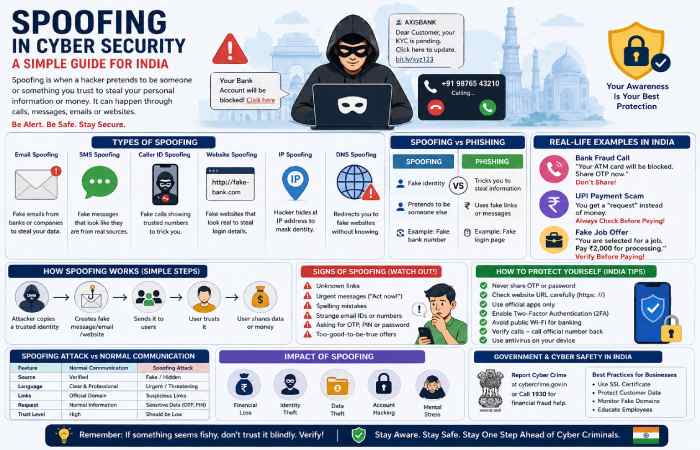
Spoofing means fake identity.
Cyber security spoofing involves an individual or system masquerading as a legitimate entity such as banks, companies, or an individual in order to deceive others.
Example:
A message appears to come from your bank, although it comes from a fraudulent party.
Why Spoofing is a Big Problem in India
India ranks among the top digitally growing nations in the world. As a result, we have:
- Growing use of UPI payment applications (e.g., PhonePe, Google Pay, and Paytm)
- Mobile internet users are growing fast
This gives more chances for scammers to target people.
Common Indian scenarios:
- Fake bank SMS
- Fake OTP calls
- WhatsApp impersonation
- Fake government scheme messages
Types of Spoofing in Cyber Security
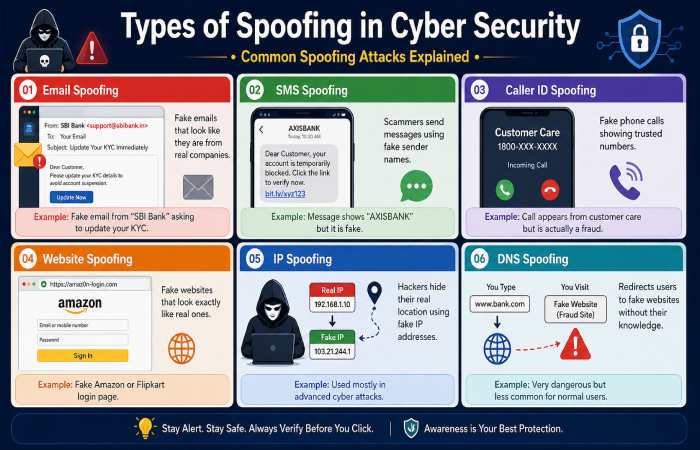
Here are the most common types:
- Email Spoofing
Fake emails that look like they are from real companies.
Example: Fake email from “SBI Bank” asking to update your KYC.
- SMS Spoofing
Scammers send messages using fake sender names.
Example: Message shows “AXISBANK” but it is fake.
- Caller ID Spoofing
Fake phone calls showing trusted numbers.
Example: Call appears from customer care but is actually a fraud.
- Website Spoofing
Fake websites that look exactly like real ones.
Example: Fake Amazon or Flipkart login page.
- IP Spoofing
Hackers hide their real location using fake IP addresses.
Used mostly in advanced cyber attacks.
- DNS Spoofing
Redirects users to fake websites without their knowledge.
Very dangerous but less common for normal users.
Network-related topics are also covered in IoT explained.
Spoofing vs Phishing
| Feature | Spoofing | Phishing |
| Meaning | Fake identity | Fake message to steal data |
| Main Goal | Gain trust | Steal sensitive information |
| Method | Looks like real person/system | Tricks user to click or share data |
| Example | Fake bank number | Fake login page link |
| Risk Level | Medium to High | High |
Simple understanding:
- Spoofing = pretending
- Phishing = stealing through trick
Real-Life Examples in India
Example 1: Bank Fraud Call
A person receives a call saying:
“Your ATM card will be blocked. Share OTP now.”
This is spoofing + fraud.
Example 2: UPI Payment Scam
You receive a “request” instead of money.
You think you are receiving money but actually sending it.
Example 3: Fake Job Offer
Email says:
“You are selected for a job. Pay ₹2,000 for processing.”
This is spoofing of company identity.
How Spoofing Works (Simple Steps)
- Attacker copies a trusted identity
- Creates fake message/email/website
- Sends it to users
- User trusts it
- User shares data or money
Signs of Spoofing (How to Identify)
Watch for these warning signs:
- Unknown links
- Urgent messages (“Act now!”)
- Spelling mistakes
- Strange email IDs
- Asking OTP or password
- Too-good-to-be-true offers
Spoofing Attack vs Normal Communication
| Feature | Normal Message | Spoofing Message |
| Source | Verified | Fake/hidden |
| Language | Clear and professional | Urgent or threatening |
| Links | Official domain | Suspicious links |
| Request | Normal info | Sensitive data (OTP, PIN) |
| Trust Level | High | Should be low |
Impact of Spoofing
Spoofing can cause:
- Financial loss
- Identity theft
- Data theft
- Account hacking
- Mental stress
How to Protect Yourself from Spoofing (India Tips)
- Never Share OTP
Banks in India never ask for OTP.
- Check Website URL
Always check:
- https://
- correct spelling
- Use Official Apps Only
Download apps from:
- Google Play Store
- Apple App Store
- Enable Two-Factor Authentication (2FA)
Adds extra security to accounts.
- Avoid Public Wi-Fi for Banking
- Verify Calls
If unsure, call official number.
- Use Antivirus Software
Government and Cyber Safety in India
India has cyber awareness programs:
- Cyber Crime Portal: https://cybercrime.gov.in
- Helpline: 1930 (for fraud cases)
Best Practices for Businesses
If you run a website or business:
- Use SSL certificate
- Protect customer data
- Monitor fake domains
- Educate employees
Future of Spoofing Attacks
Spoofing is becoming more advanced with:
- AI-generated voices
- Deepfake videos
- Smart phishing emails
So awareness is very important.
Frequently Asked Questions (FAQs)
- Is spoofing illegal in India?
Yes, spoofing used for fraud is illegal under IT Act.
- Can spoofing steal money?
Yes, especially through UPI and bank scams.
- Is spoofing same as hacking?
No. Spoofing is tricking, hacking is breaking into systems.
- How common is spoofing in India?
Very common due to high digital usage.
- Can spoofing be stopped completely?
No, but it can be reduced with awareness and security.
Conclusion
Cyber security spoofing has become one of the major problems for a developing country like India. This spoofing creates a false identity in order to deceive others.
The good thing about all this is that with a little knowledge and some basic safety measures, you will be safe.
Here’s what you need to keep in mind:
If something seems fishy, do not believe it at face value. Verify!
Humanize Text