
Table of Contents
Introduction
Look around you for a moment.
Your phone is connected to the internet. Your TV can stream videos. Your watch can track your health. Even your home appliances are becoming smarter.
All these devices are not working alone anymore — they are connected.
This is where IoT (Internet of Things) comes into the picture.
Many people think IoT is something complex or only for big companies. But in reality, it is already part of daily life.
IoT is about devices talking to each other using the internet.
It saves time, reduces effort, and makes life easier.
Modern technology is moving towards connected systems where devices communicate and automate tasks efficiently.
What is IoT (Internet of Things)?
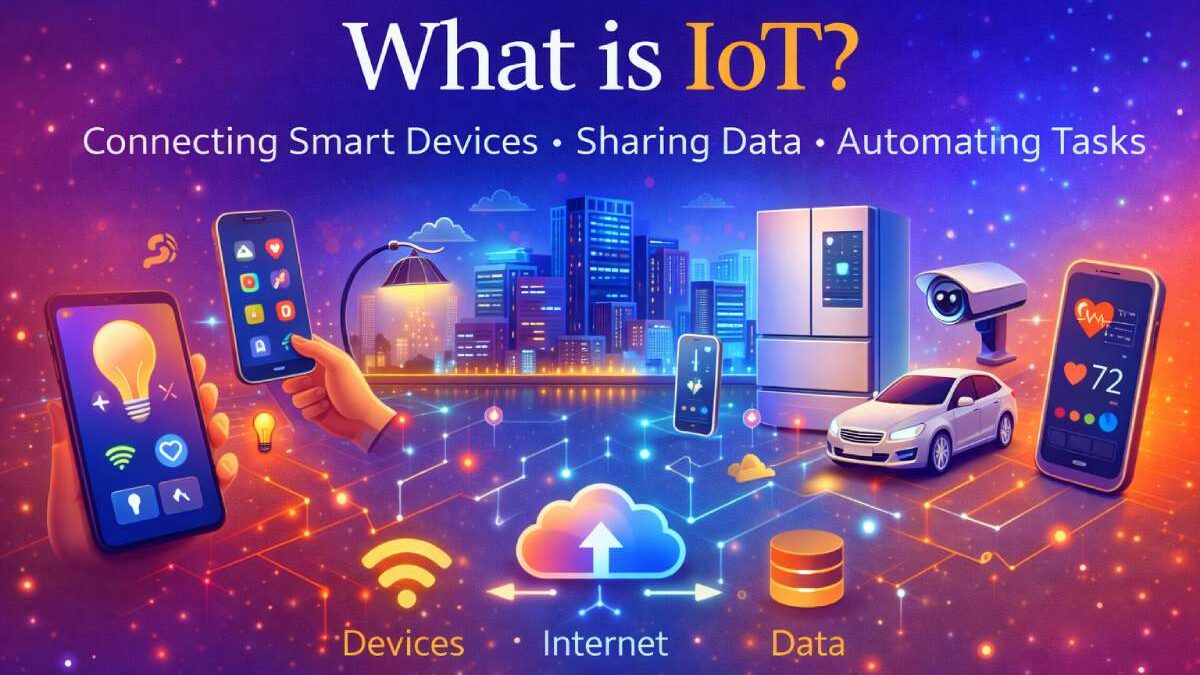
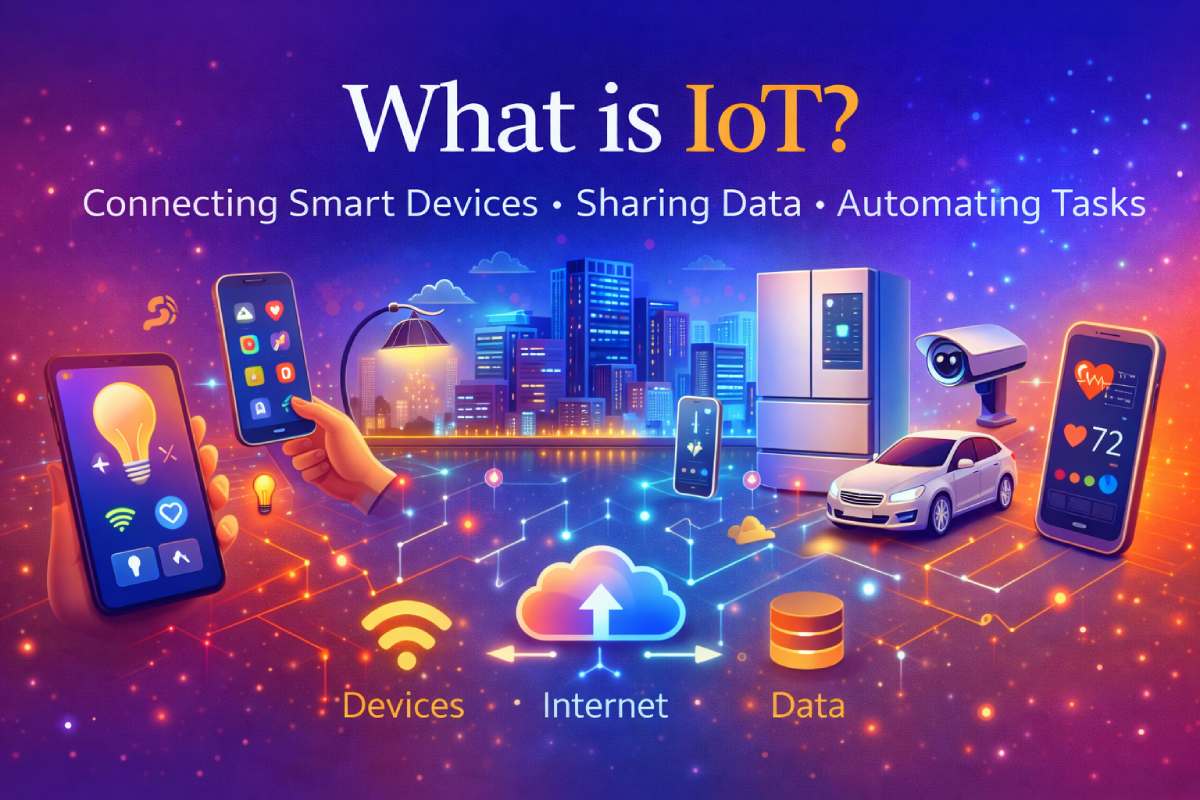
IoT means connecting everyday objects to the internet so they can send and receive data. According to IBM, the Internet of Things refers to physical devices connected to the internet that collect and exchange data.
These objects are not just computers or phones. They can be:
- Lights
- Fans
- Cars
- Watches
- Security systems
Simple definition:
IoT = Physical devices + Internet + Data exchange
Why IoT is Becoming So Popular
Today, people want:
- Convenience
- Speed
- Automation
Nobody wants to do everything manually anymore.
IoT helps by:
- Automating tasks
- Giving real-time information
- Reducing human effort
Example:
Instead of checking the temperature again and again, a smart AC adjusts automatically.
How IoT Works (Step-by-Step Simple)
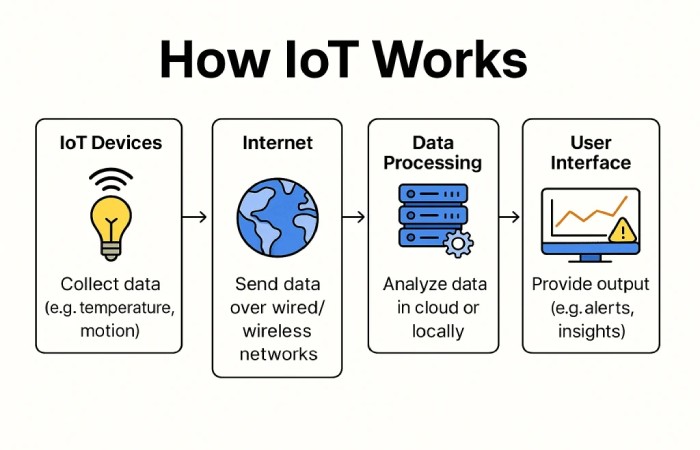
Let’s understand this in the easiest way.
Step 1: Data Collection
Devices have sensors.
These sensors collect data like:
- Temperature
- Movement
- Location
- Heart rate
Step 2: Data Transfer
The device sends data through:
- Wi-Fi
- Bluetooth
- Mobile network
Step 3: Data Processing
Data is processed using:
- Cloud systems
- Edge computing
Step 4: Action
The system takes action based on data.
Example:
- Light turns on
- Alert is sent
- Machine adjusts settings
Real-Life Example (Easy to Understand)
Smart Door Lock
- Detects your phone nearby
- Unlocks automatically
- Sends notification
Types of IoT Devices
| Type | Example |
| Consumer IoT | Smart TV, Smart Watch |
| Industrial IoT | Factory machines |
| Commercial IoT | Smart billing systems |
| Infrastructure IoT | Traffic control systems |
Real-Life Examples of IoT
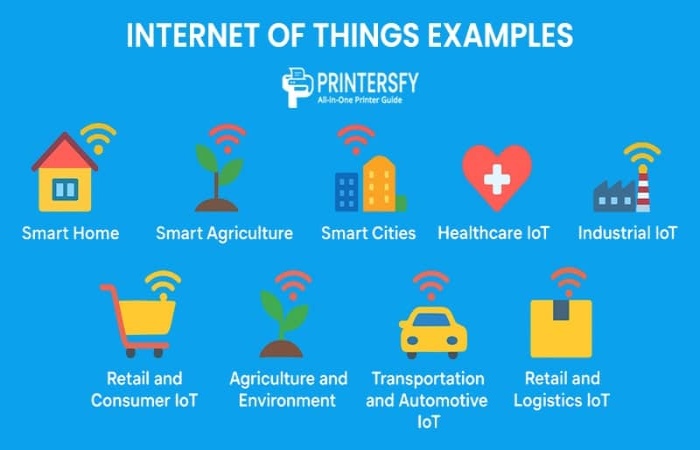
1. Smart Homes
This is the most common use of IoT.
Devices include:
- Smart lights
- Smart plugs
- Smart cameras
You can control everything from your phone.
Experts at Cisco explain that IoT enables smart homes where devices communicate to improve convenience and efficiency.
More Simple Examples of IoT in Daily Life
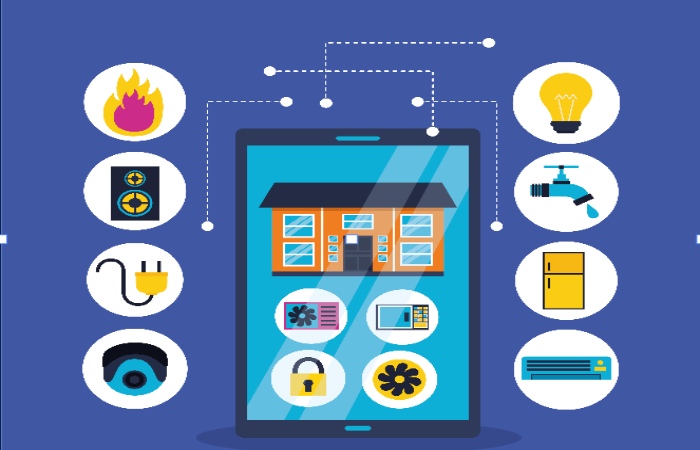
IoT is not only used in big systems. It is also part of small daily activities.
Smart Refrigerator
A smart fridge can:
- Track food items
- Suggest recipes
- Alert when something is about to expire
This helps reduce food waste.
Smart Washing Machine
- Can be controlled using a mobile app
- Adjusts washing based on clothes type
Saves time and effort.
Smart Doorbell
- Shows who is at the door
- Sends alert to your phone
Improves home security.
Smart Energy Meter
- Tracks electricity usage
- Shows real-time data
Helps reduce bills.
2. Healthcare
IoT is changing healthcare.
Examples:
- Fitness bands
- Heart rate monitors
- Remote patient tracking
Doctors can monitor patients from anywhere.
3. Smart Cars
Modern cars use IoT features like:
- GPS tracking
- Real-time traffic updates
- Automatic braking
Improves safety and driving experience.
4. Agriculture
Farmers use IoT for:
- Soil moisture tracking
- Smart irrigation systems
Saves water and increases productivity.
5. Smart Cities
Cities are becoming smarter with IoT.
Examples:
- Smart traffic signals
- Smart parking systems
- Waste management tracking
Reduces congestion and improves life.
IoT in Daily Life
| Area | Device | Use | Benefit |
| Home | Smart bulb | Remote control | Convenience |
| Health | Smartwatch | Track fitness | Better health |
| Transport | GPS | Navigation | Saves time |
| Office | Smart system | Automation | Efficiency |
Components of IoT (Simple Breakdown)
- Devices / Sensors
Collect data from environment
- Connectivity
Transfers data via internet
- Processing System
Analyzes data (cloud or edge)
- User Interface
Displays data to users (apps)
IoT vs Traditional Systems
| Feature | IoT | Traditional |
| Control | Automatic | Manual |
| Speed | Fast | Slow |
| Accuracy | High | Medium |
| Data | Real-time | Limited |
Benefits of IoT
- Saves Time
Automation reduces manual effort
- Improves Efficiency
Devices work smarter
- Better Decision Making
Data helps in planning
- Cost Saving
Less energy waste
- Convenience
Control everything from one place
How IoT Saves Money
Many people think IoT is expensive, but it can actually save money.
Examples:
- Smart lights turn off automatically → save electricity
- Smart AC uses less power → reduces bill
- Smart irrigation saves water → reduces cost
Over time, these small savings become big.
Challenges of IoT
- Security Risks
More devices = more vulnerability
- High Initial Cost
Setup can be expensive
- Internet Dependency
Needs stable connection
- Data Privacy Issues
User data must be protected
Simple Ways to Use IoT Safely
Using IoT safely is very important.
Here are some easy tips:
- Use strong passwords
- Update devices regularly
- Avoid unknown apps
- Use secure Wi-Fi
Small steps can protect your data.
IoT + AI (Latest Trend)
When IoT combines with AI:
- Devices learn behavior
- Systems become smarter
- Automation improves
Example:
A smart AC learns your routine and adjusts temperature automatically.
IoT + Edge Computing
Instead of sending all data to cloud:
- Data is processed nearby
- Faster response
This reduces delay
IoT Use Cases by Industry
| Industry | Use Case |
| Healthcare | Remote monitoring |
| Retail | Smart checkout |
| Manufacturing | Automation |
| Transport | Traffic systems |
IoT vs Edge vs Cloud
| Feature | IoT | Edge | Cloud |
| Role | Data collection | Processing | Storage |
| Speed | Depends | Fast | Medium |
| Use | Devices | Local systems | Central systems |
Latest IoT Trends (2026)
This section helps ranking
- AI Integration
Smarter devices
- 5G Connectivity
Faster communication
- Smart Cities
Urban automation
- Industrial IoT
Factory automation
- Wearable Technology
Health tracking
Common Mistakes People Make
- Using IoT without need
- Ignoring security
- Over-depending on automation
When Should You Use IoT?
Use IoT if:
- You want automation
- You need real-time updates
- You want better control
Future of IoT
IoT will grow very fast.
Future includes:
- Fully automated homes
- Smart hospitals
- Driverless vehicles
Everything will be connected
How IoT is Changing Jobs
IoT is creating new job opportunities.
New roles include:
- IoT engineers
- Data analysts
- Smart system designers
At the same time:
- Some manual jobs are reducing
People need to learn new skills.
Advantages vs Disadvantages of IoT
| Advantages | Disadvantages |
| Saves time | Security risk |
| Improves efficiency | High cost |
| Easy control | Internet dependency |
| Better data | Privacy issues |
Is IoT Used in Mobile Phones?
Yes, IoT is already used in smartphones.
Examples:
- Location tracking
- Health apps
- Smart home control
Your phone is a major IoT device.
IoT in India (Growing Fast)
IoT is growing quickly in India.
Used in:
- Smart cities projects
- Agriculture systems
- Healthcare monitoring
Government and companies are investing in IoT.
Small Daily Habits Using IoT
You may already use IoT without noticing.
Examples:
- Checking weather on phone
- Using GPS while traveling
- Tracking steps on smartwatch
These small habits show how IoT is part of life.
Frequently Asked Questions
What is IoT in simple words?
Connecting devices to internet to share data.
Where is IoT used?
Homes, cars, healthcare, cities.
Is IoT safe?
Yes, with proper security.
Is IoT expensive?
Initial setup can be high, but long-term savings are good.
Personal Insight (Human Tone)
From daily life experience, IoT is already everywhere.
We use it without noticing:
- Checking steps on smartwatch
- Using GPS
- Controlling devices with phone
The biggest benefit is convenience.
But it is important not to depend too much and always focus on security.
Conclusion
IoT is not just a technology — it is a lifestyle change.
It connects devices, improves efficiency, and makes life easier.
As technology grows, IoT will become even more important in daily life.
Understanding it now will help you stay ahead in the future.