
Table of Contents
Introduction
Many individuals in Brazil use the Internet daily for purposes such as conducting transactions through online banking services, downloading movies on YouTube, and engaging in online shopping. The majority of the population does not understand the process involved in transferring their data over the Internet.
A Virtual Private Network (VPN) tunnel plays an essential role in safeguarding the transfer of data from hacking attempts while using public WiFi services in Brazil.
In this paper, the nature of a virtual private network (VPN) tunnel and the importance of having it in Brazil will be discussed.
What Is a VPN Tunnel?
What Is a VPN Tunnel?
A VPN tunnel is a secured and private route that exists between your computer and the internet.
Put differently:
Regular internet access = an open highway (everyone can see)
VPNN tunnel = a private passage (concealed and safe)
Using a VPN tunnel allows you to:
- Your data is encrypted (locked)
- Your real IP address is hidden
- Your online activity is more private
How a VPN Tunnel Works
A VPN tunnel may sound technical, but the idea is simple. It works like a protected path between your device and the internet. This path keeps your data safe from outsiders.
Let’s break it down step by step in a clear and practical way.
Step 1: You Connect to a VPN App
First, you open a VPN app on your phone, laptop, or computer.
- You choose a server (for example, a server in Brazil)
- Then you tap “connect”
Once connected:
- Your device is no longer using a normal internet path
- It starts using a secure VPN connection
Think of it like switching from a public road to a private road.
Step 2: The VPN Creates a Secure Tunnel
After connecting, the VPN builds a virtual tunnel between:
- Your device
- The VPN server
This tunnel is not physical. It is created using software and encryption.
You can explore secure apps in best AI apps Android
What this means:
- No one outside can enter this tunnel
- Your data is protected while traveling
Simple idea:
It’s like sending your data through a sealed pipe instead of an open road.
Step 3: Your Data Travels Through the Tunnel
When you browse a website or use an app:
- Your request goes into the VPN tunnel
- It travels safely to the VPN server
For example:
- You open a website
- The request goes through the tunnel first
- Then it reaches the internet
Step 4: Data Is Encrypted (Scrambled)
Before your data enters the tunnel, the VPN does something very important—it encrypts your data.
Encryption means:
- Your data is converted into a secret code
- Only the VPN server can read it
If someone tries to see your data:
- They will only see random, unreadable information
Example:
Normal text: Hello
Encrypted: X7#kP!9
This makes your information safe from:
- Hackers
- Network attackers
- Unsecured Wi-Fi risks
Step 5: VPN Server Sends Data to the Internet
After your data reaches the VPN server:
- The server decrypts (unlocks) it
- Then sends it to the website or app you want
Important point:
- The website sees the VPN server’s IP address
- It does NOT see your real IP address
This helps protect your identity.
Step 6: Data Comes Back Safely
When the website sends data back:
- It goes to the VPN server first
- Then enters the secure tunnel again
- Finally reaches your device
So the full journey is:
Your Device → VPN Tunnel → VPN Server → Internet → Back through Tunnel
Simple Flow Example
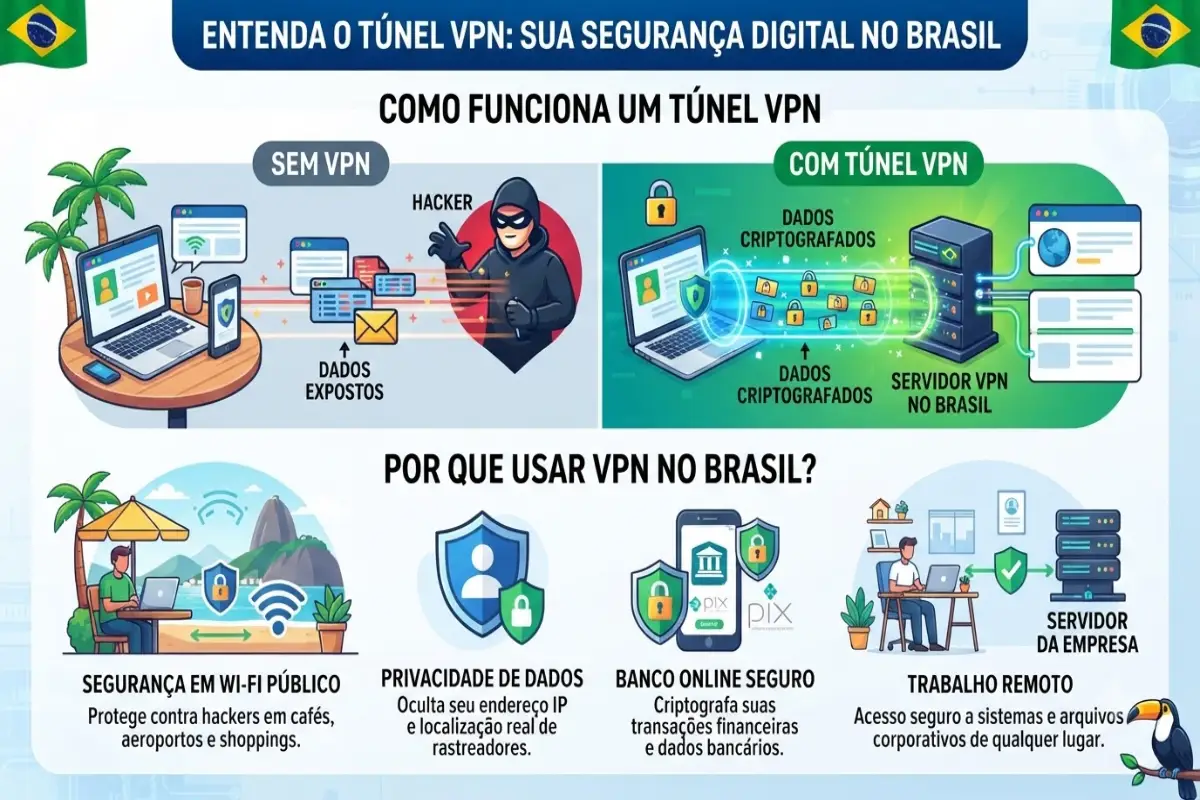
Without VPN:
- Your data travels openly
- Others may see it
With VPN tunnel:
- Your data is locked
- It travels safely
- Only you and the VPN can read it
Easy Real-Life Example (Brazil)
Without VPN:
- Anyone on the same network may try to watch your activity
With VPN:
- Your data is encrypted
- Even if someone sees it, they cannot understand it
Quick Summary Table
| Step | What Happens | Why It Matters |
| Connect to VPN | Start secure connection | Begins protection |
| Create Tunnel | Private path is built | Blocks outsiders |
| Data Travels | Goes through tunnel | Safe transfer |
| Encryption | Data is scrambled | Prevents spying |
| VPN Server | Sends request forward | Hides your identity |
| Return Data | Comes back securely | Full protection |
VPNs normally go unnoticed, but their purpose is extremely important. They protect your information from any viewing, stealing, or misuse.
Though there may be efforts to spy on what you do online, all you’ll receive is an encoded version of the data. So in that way, it could be said that tunneling is a great means of secure surfing.
Example in Brazil
Without VPN:
- Your data can be seen by others on the same network
With VPN tunnel:
- Your data is locked and hidden
- No one can read it
Why VPN Tunnel Is Important in Brazil
Internet usage is increasing rapidly in Brazil. Internet access via mobile data connections, wireless broadband at home, or public wireless access points is done on a daily basis. Personal information is constantly being shared via banking applications, social networks, and office tasks online. As such, there is a need for people in Brazil to make increased use of a virtual private network (VPN) tunnel.
Following are some of the primary reasons:
1. Public Wi-Fi Safety
Cities in Brazil where you can find free Wi-Fi include:
- Cafés
- Shopping malls
- Airports
- Hotels
These networks are useful, but they are not always secure.
When you connect to public Wi-Fi without protection:
- Hackers on the same network can try to see your data
- Your passwords and personal details may be at risk
A VPN tunnel solves this problem by:
- Encrypting (locking) your data
- Making it unreadable to others
So even if someone tries to access your information, they will not understand it.
Simple idea:
Public Wi-Fi = open space
VPN tunnel = locked private path
2. Privacy Protection
In fact, websites, applications, and even internet service providers are capable of monitoring your activities online. This is also true in Brazil, just like in other countries, where personal data is gathered for advertising and analysis purposes
Without a VPN:
- Your IP address is visible
- Your browsing activity can be tracked
With a VPN tunnel:
- Your IP address is hidden
- Your activity becomes private
This is useful if you:
- Do not want tracking
- Privacy protection during searching
- Enhanced security when surfing
This provides users with greater digital privacy protection.
3. Safe Online Banking
Online banking is very common in Brazil. People use apps for:
- Checking balance
- Sending money (PIX transfers)
- Paying bills
- Shopping online
This makes security very important.
Without protection:
- Hackers may try to steal login details
- Fake networks can capture your data
With a VPN tunnel:
- Your financial data is encrypted
- Transactions become safer
Even when using public or unknown networks, your information stays protected.
This is especially important when using banking apps outside your home network.
4. Remote Work Security
Remote work has increased in Brazil. Many professionals now work from:
- Home
- Co-working spaces
- Cafés
They often need access to:
- Company files
- Internal systems
- Emails and documents
Companies require secure connections because:
- Business data is sensitive
- Data leaks can cause serious problems
A VPN tunnel helps by:
- Creating a secure connection to company servers
- Protecting work data from outsiders
- Allowing safe access from any location
This is why many companies in Brazil require employees to use VPNs.
Quick Summary Table
| Reason | Why It Matters in Brazil | How VPN Helps |
| Public Wi-Fi Safety | Free Wi-Fi is common but risky | Encrypts data |
| Privacy Protection | Tracking and data collection | Hides identity |
| Online Banking | Financial apps widely used | Secures transactions |
| Remote Work | Many people work online | Protects company data |
Thought
In Brazil, using the internet is part of daily life. But with more usage comes more risk. A VPN tunnel is a simple tool that adds an extra layer of safety.
It helps you:
- Stay secure on public networks
- Keep your personal data private
- Protect your money and work information
For regular users, students, and professionals, it is becoming a smart and practical choice.
Types of VPN Tunnels
| Type of VPN Tunnel | Simple Meaning | Use Case |
| PPTP | Basic and fast | Old systems |
| L2TP/IPSec | More secure | General use |
| OpenVPN | Strong security | Most popular |
| WireGuard | Fast and modern | New users |
VPN Tunnel vs Normal Internet
| Feature | Normal Internet | VPN Tunnel |
| Security | Low | High |
| Privacy | Low | High |
| Data Protection | No | Yes |
| Speed | Normal | Slightly slower |
| IP Address | Visible | Hidden |
Advantages of VPN Tunnel
- Keeps your data safe
- Protects your identity
- Works on public Wi-Fi
- Helps in remote work
- Adds extra security layer
Disadvantages of VPN Tunnel
- Can reduce internet speed slightly
- Some VPN services cost money
- Not all VPNs are trustworthy
Is VPN Legal in Brazil?
Yes, VPN is legal in Brazil.
People use VPNs for:
- Privacy
- Security
- Work purposes
But using VPN for illegal activities is not allowed.
Common Uses of VPN Tunnel in Brazil
- Students protecting their data
- Office workers accessing company systems
- Travelers using public Wi-Fi
- Regular users who want privacy
Simple Diagram Explanation
Without VPN:
Your Device → Internet → Website
(Data is visible)
With VPN Tunnel:
Your Device → VPN Tunnel → Internet → Website
(Data is encrypted and hidden)
How to Choose a Good VPN in Brazil
Look for these features:
- Strong encryption
- No-logs policy
- Fast speed
- Servers in Brazil
- Easy to use
Tips for Safe VPN Use
- Use trusted VPN providers
- Avoid free unknown VPNs
- Keep app updated
- Do not share sensitive data unnecessarily
FAQs About VPN Tunnel
- What is a VPN tunnel in simple words?
It is a safe and secure tunnel which encrypts data online.
- Is the use of VPN in Brazil safe?
Yes, it is perfectly safe to use.
- Will the use of a VPN slow down the internet speed?
Sometimes, but good ones do not.
- Can a VPN mask my real location?
Yes, it can mask your real IP.
- Do I have to use it everyday?
Not always, but useful on public Wi-Fi.
Conclusion
Tunneling from the device to the server becomes a simple solution that guarantees that you will be secure online. Your presence in Brazil and frequent use of public wi-fi networks become a good reason to opt for using a VPN service.
Being simple, legal, and user-friendly, a tunnel will be useful for the protection of regular internet users.